
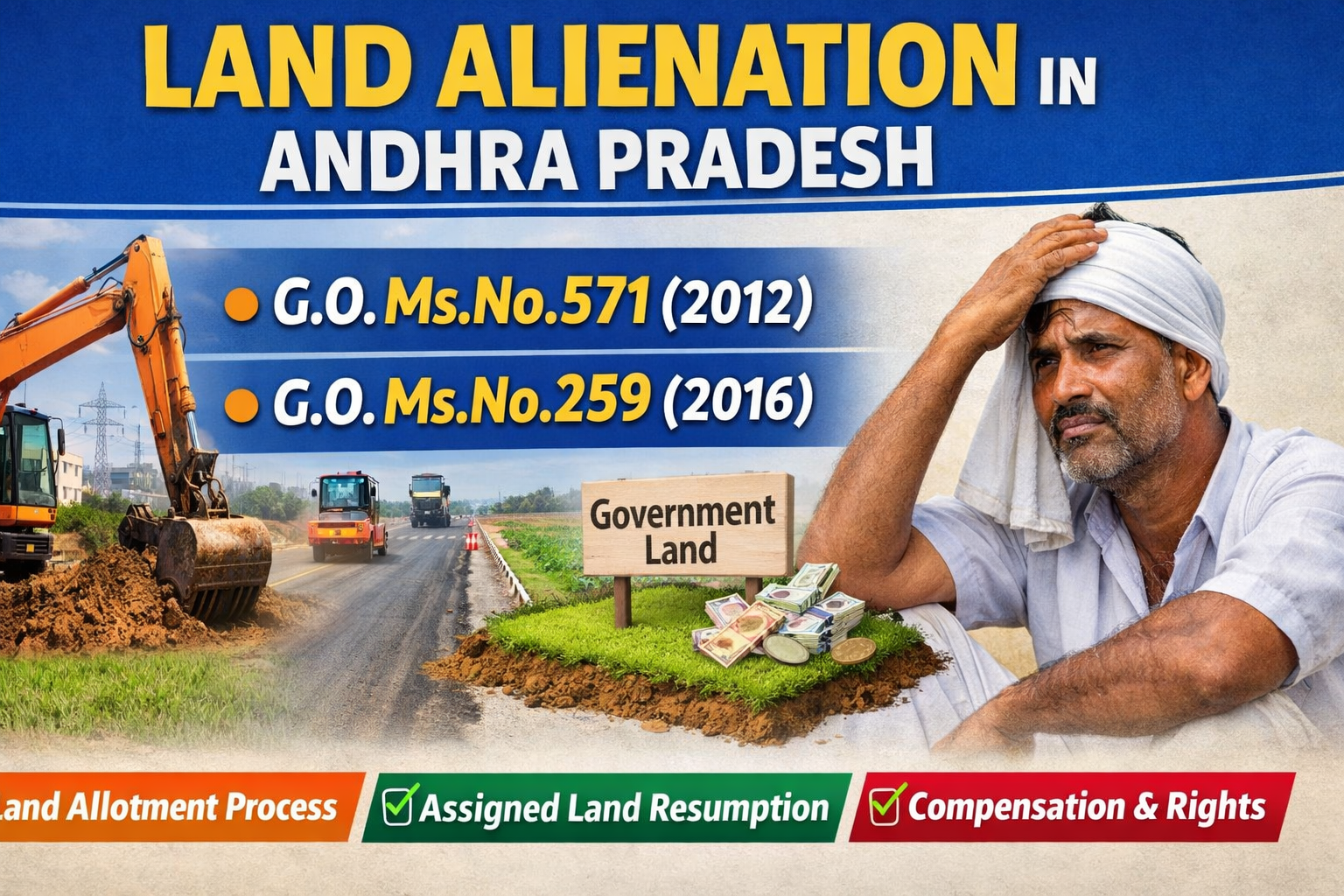

Is the Government taking your D-Patta land in the name of road, industry, educational institution, or project?
Are they saying “Since it is Assigned Land, there is no compensation”?
Is Government land assignment a sale? Or only a lease?
What happens if the land taken for a project is not utilized?
Does an Assigned land holder really have legal rights?
These are the questions currently faced by thousands of farmers and landholders in Andhra Pradesh. As per G.O.Ms.No.571 and G.O.Ms.No.259, it is extremely necessary to clearly understand the procedure of government land assignment, resumption of assigned lands, and compensation under the RFCTLARR Act, 2013. In this article, the complete procedure of land alienation, legal protections, compensation rights, and step-by-step process are comprehensively explained.
Land Alienation in Andhra Pradesh – Complete Procedure, Compensation, and Process as per G.O.Ms.No.571 & G.O.Ms.No.259
What is Land Alienation?
Land Alienation means the official assignment of government land under the control of the Government to a concerned department / institution / industry / educational institution for a specific public purpose.
It is not a normal land sale. Generally, it is in the following forms:
- Lease
- Conditional assignment
- Right of use
In Andhra Pradesh, Land Alienation is mainly governed by two Government Orders:
- G.O.Ms.No.571, dated: 14-09-2012 – Policy for assignment of Government lands
- G.O.Ms.No.259, dated: 21-06-2016 – Resumption of Assigned Lands & Compensation
G.O.Ms.No.571 – Policy for Assignment of Government Lands
Through this order, a comprehensive policy for assignment of government lands across the State was implemented. The details are as follows:
Public Purpose
The following come under public purpose:
- Roads
- Railways
- Ports and Airports
- Industries
- Power projects
- Educational and Medical institutions
- Housing for the poor
- Infrastructure projects
Generally, Government land will not be given for private purposes (except in special cases).
Land Assignment Criteria
- The extent of land required for each project shall be specified.
- Guidelines of the concerned regulatory authorities must be followed.
- Cultivable lands, tank bunds, riverbeds, hill areas shall not be assigned.
- In major projects, 10% of the land shall be reserved for future public purposes.
Determination of Market Value
- Market value shall be determined through local enquiry.
- It shall not be less than the basic value.
- Up to ₹1 crore → Recommendation by RDOAbove ₹1 crore → Recommendation by Collector
Lease and Sale Procedure
- Preference is given to lease method.
- Maximum lease period → 33 years.
- Lease amount → 10% of market value.
- 10% increase every 5 years.
- Direct sale → Only in very special cases.
Andhra Pradesh Land Management Authority (APLMA)
Through G.O.571, APLMA was constituted. Responsibilities of APLMA:
- Examination of land assignment proposals
- Environmental impact review
- Maintenance of online land bank
- Monitoring and resumption powers
G.O.Ms.No.259 – Resumption and Compensation of Assigned Lands
This order mainly applies when D-Form patta lands are resumed for public purpose.
Key Points:
- Assigned lands may be resumed if required for public purpose
- Compensation → As per RFCTLARR Act, 2013
- Assignee shall be treated as an “Affected Family”
- Full compensation shall be given similar to private patta lands
This means that holders of assigned lands are now entitled to full statutory compensation under law, not merely ex-gratia.
Complete Land Alienation Process (Step-by-Step)
Step 1: Requisition by Requiring Department
When a department requires land for public purpose, it submits a formal request to the District Collector with details of required extent, project details, site map, and justification.
Step 2: Preliminary Scrutiny by Collector
The District Collector directs revenue authorities to examine whether the land is government land, assigned land, whether encroachments exist, and whether it falls under prohibited categories (tanks, riverbeds, hill areas, etc.).
Step 3: Site Inspection and Report
- Tahsildar conducts site inspection and submits report
- RDO reviews
- Classification of land (Government / Assigned / Private)
- Verification whether it falls in prohibited zones or within 2 km of Mandal headquarters
Step 4: Determination of Market Value
- Local enquiry for valuation
- Not less than basic registration value
- Up to ₹1 crore → RDO recommendation
- Above ₹1 crore → Collector recommendation
Step 5: Examination by APLMA (as per G.O.Ms.No.571)
Proposal is sent to APLMA. APLMA examines:
- Justification of land extent
- Environmental impact review
- NOC from local bodies
- Zonal and land use approvals
- 10% reservation for future public purpose in major projects
Step 6: Government Approval (Issue of G.O.)
Based on APLMA recommendations, the State Government issues final Government Order. Without G.O., land assignment is invalid.
Step 7: Lease / Conditional Assignment
- Generally lease method (maximum 33 years)
- Lease amount → 10% of market value
- 10% increase every 5 years
- Direct sale → Only in special cases
Conditions:
- Utilization within specified time
- Establishment of green belt
- Prohibition on change of land use
- No transfer without permission
Step 8: Monitoring and Inspections
- Quarterly site inspections
- Land Audit Committee review
- Project progress reports
Step 9: Violation or Non-Utilization
- Violation of conditions → Resumption action
- If not utilized → Land reverts to Government
- If assigned (D-Patta) land → Full compensation under RFCTLARR Act, 2013 as per G.O.Ms.No.259
Special Procedure in Case of Assigned Lands (as per G.O.Ms.No.259)
- Assignee shall be treated as “Affected Family”
- Compensation = Market value + Solatium + R&R benefits
- Mere ex-gratia payment is not sufficient
Special Procedure When Assigned Lands Exist
If D-Form patta lands are included in alienation proposal:
- Resumption as per patta conditions
- Compensation under RFCTLARR Act, 2013
- Rehabilitation and Resettlement benefits
Important Legal Protections
- Assignment of tanks and water bodies prohibited
- Restrictions within 2 km radius of Mandal headquarters
- Environmental and zonal approvals mandatory
- Unutilized land → Reversion to Government
- 10% land reservation in major projects
Benefits of Land Alienation
- Industrial development
- Increase in employment opportunities
- Infrastructure development
- Expansion of educational and medical sectors
- Planned urban development
What to do if Government or Private Entity Occupies Land Without Compensation?
If Government or a private entity with Government approval acquires land in the name of public purpose without paying lawful compensation, the landowner has the following legal rights and remedies:
Right under RFCTLARR Act, 2013
Under the Right to Fair Compensation and Transparency in Land Acquisition, Rehabilitation and Resettlement Act, 2013, it is mandatory to pay fair and proper compensation before acquiring land. Compensation shall be based on market value, with higher multiplier in rural areas. Rehabilitation and financial assistance must be provided. Consent of affected people is required for private projects. The process must be transparent and include Social Impact Assessment. If acquisition is done without following legal procedure or without proper compensation, affected persons have the right to approach Court. Thus, the Act protects property rights.
Under RFCTLARR Act, 2013:
- Prior notice must be given
- Social Impact Assessment must be conducted
- Market value + Solatium + other benefits must be given
- Rehabilitation and Resettlement benefits must be provided
Occupation without compensation is illegal.
Where to Complain in Case of Illegal Occupation?
- Tahsildar
- RDO
- District Collector
Submit written representation with survey number and patta details and obtain acknowledgement receipt.
Legal Remedies
Writ Petition in High Court (Article 226)
If land is taken without compensation, “Writ of Mandamus” or “Writ of Certiorari” may be filed.
Court may:
- Direct payment of compensation
- Declare occupation illegal
- Order restoration of land
Civil Suit
For illegal occupation:
- Declaration suit
- Injunction suit
- Damages claim
If Assigned (D-Patta) Land
As per G.O.Ms.No.259:
- Assignee treated as “Affected Family”
- Full compensation under RFCTLARR Act
- Ex-gratia alone is not sufficient
Taking possession without compensation is not lawful.
If Private Entity Occupies in the Name of Government Land
- Private entity cannot directly take land.
- Government Order (G.O.) is mandatory.
Without G.O.:
- It is treated as illegal occupationØ
- Revenue records must be verifiedØ
- Legal protection can be sought in High CourtØ
Important Legal Principle
As per Article 300-A of the Constitution of India, “No person shall be deprived of his property save by authority of law.” Therefore, land cannot be taken merely based on administrative order, oral instruction, or departmental letter. Land acquisition must follow statutory procedure including notice, enquiry, market value determination, and compensation payment. Any acquisition without following law is unconstitutional.
Conclusion:
Land Alienation is not a simple land assignment process. It is a regulated and legally structured procedure implemented under Government control for specific public purposes. While G.O.Ms.No.571 provides a clear framework for assignment of government lands, G.O.Ms.No.259 ensures that even assigned landholders are entitled to full compensation under RFCTLARR Act, 2013. Therefore, whether it is D-Patta land or private patta land — when land is taken for public purpose, transparent procedure, proper market value, and rehabilitation rights are mandatory. It is extremely important for landowners to understand their legal rights and protections.
Convert in Telugu
2 thoughts on “Land Alienation in Andhra Pradesh – Complete Guide to G.O.571, G.O.259 & Compensation Rights”